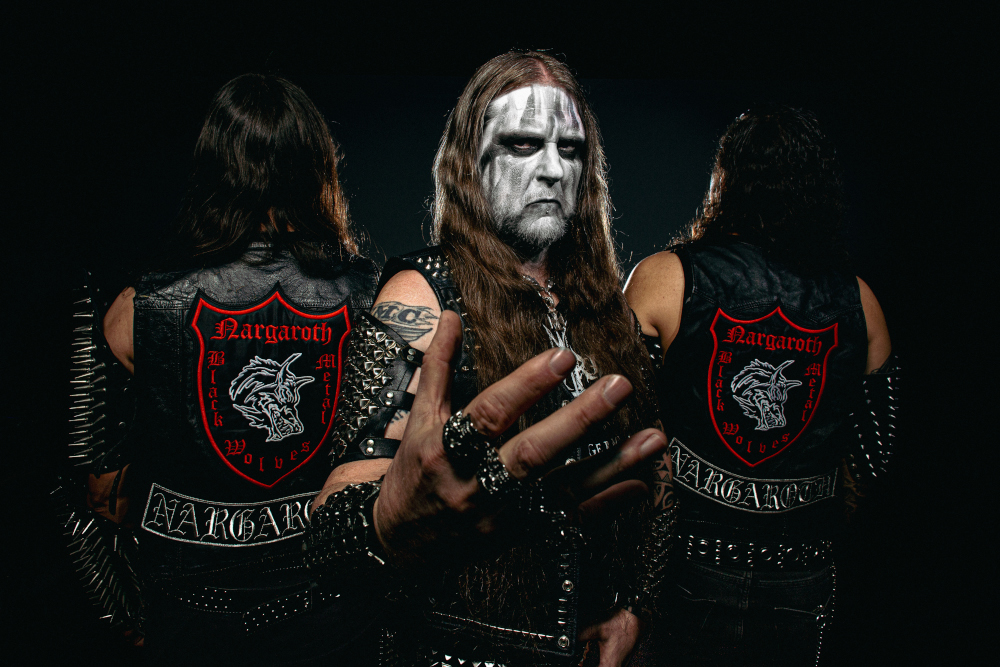
NARGAROTH return this June with their eighth full-length album Apocalyptic Steel, out June 26th via Season of Mist. Originally recorded in a single weekend back in 2014 and left forgotten on a hard drive for years before being revived, the album arrives like a delayed detonation — something buried in time that suddenly resurfaces unchanged, uncompromised, and still sharp.
This interview with Rene «Ash» Wagner follows the strange afterlife of Apocalyptic Steel — a record that survived time, travel, and disappearance — and uses it as a starting point to dig into memory, creative detours, touring chaos, industry realities, and the stubborn philosophy behind NARGAROTH after nearly three decades of existence.
Let’s begin with the upcoming album Apocalyptic Steel, due out this June. It seems to have quite an unusual story behind it: recorded in a single weekend back in 2014, then somehow left forgotten on a hard drive in the U.S. for years before resurfacing.
How does one “lose” a fully recorded album like that? And when you finally returned to those recordings nearly a decade later, was it difficult to reconnect with that same mindset and atmosphere — and present it today as something that still represents NARGAROTH in its current form?
I was in a bad place in life when I recorded it in 2014. In fact, it’s the situation I lyrically describe in my album, Era of Threnody. I was mentally checked out, a nomad on many continents and far from my best self. When I returned home to Germany, I didn’t care much about the tracks we had recorded. The other album, Era of Threnody, was also being recorded simultaneously and was progressing faster, so my attention was on that one. After the release of EoT, I travelled and lived in the USA, which was a completely different adventure, so the finished album was not on my radar.
It wasn’t difficult to reconnect with it, though. When I decided to finish it, I had rebuilt my life again, and I was in a similar state of mind to that in 2014.
Given that this release is essentially based on older material, have you already been working on something entirely new as well?
Yes, I have already started working on new material. Although I wanted to use what I had recorded in 2014, which is being released now, I am under pressure to release my new material in time and not fall behind for the rest of my career.
You’ve just wrapped up a major Latin American tour, covering a wide range of countries. Do you feel that audiences there connect more deeply with black metal than, say, metal fans in the United States?
This is an old question with a familiar answer: yes, the people there are wilder, crazier and more passionate, and they have a stronger sense of community. However, I have noticed that they are facing the same fate as the European scene. It’s become overplayed and saturated, and is more millennial. Everything has to be funny and harmless. Nevertheless, my connection to Latin America is special, and reciprocated! I have seen no other European band as intertwined as NARGAROTH.
More broadly, when you speak about your influences, you tend to mention mostly old-school death metal bands from the U.S. — does that suggest that America was never really “built” for black metal?
In the early ’90s, the metalheads in East Germany, where I lived, didn’t make the distinction between black metal and the rest. It was metal — mostly heavy, thrash and death metal. US bands were heavily promoted in Germany, so many of the bands I liked back then are from the US. The strict separation and shunning of death metal emerged in the mid-’90s. Until then, this distinction didn’t matter too much. The US had a vital BM scene early on and had some good bands, but just as other countries were not particularly respected for death metal, the US was not a country that was taken seriously for black metal.
While you were in Mexico, there was a surge of violence following reports surrounding cartel leader “El Mencho,” yet the shows went ahead as planned. Did you feel unsafe at any point?
I was feeling well, so I decided to continue with the tour instead of cancelling it, as many other bands did. Even though we were close to all of these events and were directly affected by them, I didn’t see a reason to quit. A couple of days in, however, I started to feel uneasy when the Instagram administrator posted something linking NARGAROTH to the cartel leader in a problematic way. He did so without my knowledge. We had the post taken down quickly, but we wondered if people working with the cartel might have seen it and felt compelled to ‘show up’. So, yes, there were some tensions among the crew for a few days.
My decision to continue the tour actually made national news in Mexico, and when I spoke to people on the roadside, they told me that it had given them hope. It’s the kind of belief people have in rough times: as long as certain things are fine, they will be fine. As long as NARGAROTH kept touring, displaying some sort of normality, people felt that everything would be OK, despite their country being on the brink of collapse.
After parting ways with No Colours Records, you experimented with releasing music independently. However, with NARGAROTH now on Season of Mist, it seems that approach may not have fully worked out. What challenges did you encounter along the way?
Being independent definitely has its perks. You are fully in control and the revenue is yours, minus the costs and what the government steals from you. The upside of being your own man is definitely worth it. However, it demands a lot of your time and energy, and the business side of making music can actually take away the magic, lightness and fun.
When I moved to the USA in 2016, I couldn’t manage the business as I had before. So I outsourced it, but it didn’t work out as I had hoped. I usually made handshake deals, but no one adheres to them anymore, no matter how loudly they scream ‘old-school’ in their bio.
In 2022, I signed with SoM. I am not accustomed to working with a major label, so it took me a while to understand their methods and how the music business actually works. I needed quite a few sit-down meetings and had things explained to me in detail so that I could understand the dynamics of the entertainment market, promotional strategies, and – more importantly – what not to do in the business. I can see how SoM is using its influence to take NARGAROTH to the next level. I have to be patient to see where the road takes us.
The ever-changing market and the emotional instability of the metal scene make it hard to predict where we will end up. You can be a great band and still not make it anywhere. Conversely, you could be a mediocre band with a unique twist or a highly sought-after trait, and find yourself in top positions at major festivals. Ultimately, NARGAROTH will never be a racing car, storming the chequered flag in a glorious run. It’s more like a reliable diesel engine in an old locomotive. Sturdy, mid-paced, but reliable and consistent. I’d rather have consistent revenue than a flood of cash and be old news by the next festival season. I am confident that SoM know what they are doing, and I try to catch up along the ride.
How do you feel about the phrase “Black Metal ist Krieg” taking on a life of its own and becoming something of a meme over the years?
Nowadays, everything is a meme. Even Black Metal itself has become a gimmick and a meme. This statement is true, outdated, relevant, on point and inflationary, and it will continue even after I’m dead and gone.
You’ve traveled extensively, and at one point in 2014 you said: “I decided myself to become homeless and I started wandering the earth.” Have you since found a place — or people — you would call home?
I found my place on the earth, but when I was created, I was made a rambling man. I have always longed for the horizon and the train I hear whistling behind that hill. That’s just who I am.
How do you feel you’ve changed with age — have you become calmer, wiser, or perhaps more grounded, both as a person and as an artist?
All three properties might be suitable. I am definitely more of a loner. I don’t belong to anyone, not even the BM scene.
In one of your past interviews, you described yourself as “a German, white, cisgender male with rather old, very conservative values,” and made it clear where you stand. With the noticeable political shifts both in Europe and the United States in recent years, have you found the cultural climate becoming more comfortable for you?
To me, the world and its morals are deteriorating, and mental health issues and make-believe are becoming more prevalent. These are natural stages in the decline of a society, as we have seen before in history. I see myself as someone who is separate from everyone else. I am away from people and their desires. I don’t change — that’s the challenge. I am not fighting this uphill battle with young people who don’t yet know what they don’t know. I hope they will have the chance to enjoy the consequences of their decisions to the fullest.
You’ve referred to yourself as “an old-timer, with old values and traditional family pictures.” What do “old values” mean to you in concrete terms? Could you perhaps name a few core principles that define them?
In an ideal world, people would not deny their ancestral bloodline, and tribes, communities, ethnic groups and nations would be in harmony with their spiritual energy. No matter how outdated it is. However, a common belief system, rooted in a people’s own past and history, provides a sense of coherence and common ground through hard times.
Individuals would embrace their destiny. Whether as a masculine man or a feminine woman. These gender roles do not compete; they complement each other, and both have their place within a family, community or nation. When he builds the house, she makes it a home. When he provides the ingredients, she makes the meal. He protects, she gives it a heartbeat. He gives her love, she gives him Life. He creates a habitat in which she can dwell and be herself. He is strong enough to withstand the intensity of a woman’s energy without faltering (Standing in her Fire). She walks in the spirit of a wife even before she is married. A ring doesn’t constitute a wife, but her character does. Ideally, we would all be who we should be, and we would all be energetically connected to our true potential.
Unfortunately, however, we are all so flawed that men engage in female energy and women have to fill male roles. No wonder almost everyone is unhappy. We live against our fate. I don’t want to participate in this anymore. I have been on the wrong side of life for too long, and my time is running out. For a while, at least, I want to feel in harmony with who I should have been. That that most of what I wrote above sounds absurd, ridiculous and lame to so many out there, shows that the wrong energies are winning.
I tend to agree with your view that the black metal scene has long since become socially acceptable and domesticated. Do you see this as a final verdict for the genre, or is there still a chance for it to reclaim its former spirit?
To me, that ship has sailed. It seems to be the natural order of things for any entity to move away from its origin and become part of its surroundings, and for the surroundings to become part of it. There will always be some underground bands that sound like they did in the old days. But that won’t satisfy anyone because the times have moved on and the feeling is gone. I could dress up in the style of the 1950s. But I won’t feel like I’m in the ’50s. Nor will my surroundings perceive me as being in that emotional state. I’m just cosplaying. Such an act is merely an imitation. So no! There won’t be any chance for it to reclaim its former spirit! You can honor it with old-school sound, attitude or artwork, but it won’t feel the same. A spirit encompasses the whole experience. Flesh and soul. You can’t get this back without turning the present into the past. And we can’t do that – yet.
Finally — what are your plans for 2026?
I am a slave to my own 5-year plan. I must adhere to it if I am to find my escape. So, I will tour and release music, all the while fighting to maintain my integrity.